

This past summer, I had the opportunity to travel to New York to see the Jeremy Jordan led revival of the cult classic musical “Floyd Collins.” With music and lyrics by Adam Guettel (who is best known for his work on the musical “The Light in the Piazza”) and book and direction by Tina Landau (known best for conceiving and directing the 2017 Broadway musical adaptation of “Spongebob Squarepants”), the show follows the true story of Floyd Collins, a man who, while trying to find a way out of his boring life by discovering caves he could then give tours of for profit, ended up getting stuck 155 feet below ground thanks to a 26 pound rock pinning his foot down. Audiences watch as tension grows above ground as the Collins’ family attempt to save him, with some gathering to provide help and others coming solely for their own benefits. Ultimately, these attempts are fruitless, and Floyd ends up dying, but while Floyd may have not lived to see the fame he had earned, the importance of his tragedy lives on in our modern era. In a time where stories are launched into the public eye often without consideration for the people starring in these often tragic events and dramatized for the sake of revenue, it’s important to look back at what may well be the first example of sensationalism journalism.
Production
The concept for a musical based off of the story of “Floyd Collins” first came about in the 1980s, when Guettel and Landau, who had been students at Yale at the time, stumbled upon an article that briefly mentioned Collins’ tragedy. After its world premiere in 1994 at the Plays and Players Theatre in Philadelphia, the show premiered Off Broadway in 1996 at the Playwrights Horizons, running for 25 performances before closing. Despite its short run, “Floyd Collins” went on to win the Lucille Lortel Award for Best Musical in 1996, an Obie award for Best Score, and earned seven Drama Desk Award nominations. And while both Landau and Guettel would go on to work on many more productions, they had never really felt done with this show, and had been working on a revival for years. The fact that it opened in 2025 was merely thanks to a combination of Landau being free to direct and the Beaumont space also being available. The revival’s cast was led by Jeremy Jordan (of “Newsies” and “The Great Gatsby” fame) in the titular role, along with Jason Gotay as Homer Collins, Lizzy McAlpine as Nellie Collins, and Taylor Trensch as Skeets Miller The show began previews on March 28 after a delayed start, officially opening on April 21 and closing June 22, leading to a total number of 98 performances (26 previews, 72 performances). It was nominated for a Tony Award for Best Revival of a Musical, along with Jeremy Jordan earning his second Tony Award nomination for Best Leading Actor in a Musical and Taylor Trensch his first nomination for Best Featured Actor in a Musical.
History
Floyd Collins, born on July 20, 1887, was the oldest son of the Collins family, and lived in Kentucky on his family’s farm. Floyd was one of the many people who participated in what has been dubbed the Kentucky Cave Wars. Thanks to Mammoth Cave, the largest known cave system in the world, being located in Kentucky, many locals would explore caves on their own land, hoping to draw in tourists and turn a profit from the popularity of the cave industry. In 1917, he discovered a cave he would go on to name Crystal Cave and open to the public, and while it was somewhat successful, the Collins family was not located close enough to the Mammoth Cave Railroad Line for it to ever truly gain popularity. Floyd, however, was not dismayed, as he believed all of the nearby caves in the area were connected and wanted to find more passageways. This exploration led to Floyd discovering Sand Cave in the beginning of 1925, spending three weeks digging and even setting off dynamite in the cave on January 26 before what would be his final journey down into the cave on January 30. After making his way through the cave’s tight passageways, Floyd’s lantern would eventually begin to die. When he attempted to leave, he dislodged a 26-pound rock and ended up pinned down without the ability to escape. Diagram below:
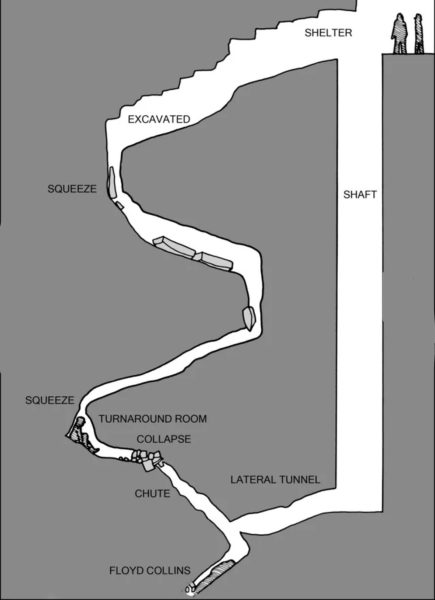
Neighbors would realize Floyd did not return home the next day, and after Jewell Estes crawled far enough into the cave to communicate with Floyd, Estes confirmed he was stuck, and his family was alerted. The next day, February 1st, locals began to gather as a disorganized rescue effort began to form. Many volunteered to go down to bring Floyd food and water, but instead hid the food in the cracks of the caves once they got scared in the cave’s passageways; some simply wanted to see Floyd for themselves.
February 2nd marks the first arrival of the media, however unlike those to follow, William “Skeets” Miller, after entering Sand Cave to speak to Floyd, joined the rescue mission. Weighing only 117 pounds, Skeets Miller was the first man that was not his older brother, Homer Collins, to reach Floyd, and his smallness allowed him to squeeze further in than Homer. During one of Skeets Miller’s attempts to get Floyd out, the trapped men began talking, leading to the interview that, once published, would make Floyd national news, as this article made him not a concept but an actual person to many readers. The next day, as Floyd’s story soared in popularity, the cave collapsed due to the amount of people who had entered and exited the cave, sealing Floyd off from those attempting to rescue him.
After only a week, 1,500 people had gathered to watch, along with several motion picture companies. Over the next few days, the crowd grew to an estimated ten to fifty thousand people, with a country fair even being set up. Newsmen from every state had arrived at this point, and the media circus surrounding Floyd even led to the first sustained use of radio for something non-political and the first trans-Atlantic call made from Cave City, Kentucky. This point marked the beginning of the rumors that would go on to be spread about Floyd, as thanks to the slow pace of the rescue mission, the news became desperate for stories. These rumors consisted of stories saying that this was all a publicity stunt to lure tourists to the caves, that Floyd had been murdered after entering the cave, that food and water was purposefully not being given to him so that he would starve, and, the most popular one, that Floyd was still alive and would leave then reenter the cave every night. The rumors had spread so far that on Monday, February 9th, it was announced that there would be a military investigation to see if his entrapment was a hoax. It took them until Saturday, February 14th, to declare that Floyd was indeed trapped, and during this time phony telegrams had been received claiming Floyd was not in the cave, adding fuel to the rumors. During this time, a shaft had been built to reach Floyd, and by the time the shaft was finished and the first rescuers descended, he was dead. Given that on the 13th diggers had heard Floyd coughing, it can be assumed he died sometime between Friday the 13th and that Monday the 16th. He was trapped for 17 days.
Why now?
So, over a hundred years later, why is it important that the story of one Kentucky man be remembered? Well, I feel the need to repeat the pieces of information that ultimately drove me to write this article. First, the cave collapsed thanks to the amount of people moving through the Sand Cave. While some, such as Skeets Miller and those building the shaft, entered with the purpose to help Floyd, many others entered for their own benefit. While we may never know if Floyd ever could have been saved, the selfish drive of those desperate to spread Floyd’s story to profit off of the curiosity surrounding it played a part in determining a man’s fate. The second piece of information is the fact that a large volume of rumors ended up being spread about the situation, with some even suspecting whether or not he was in the cave at all. These rumors get their own number in the musical in the form of a vaudeville-esque act two opener, “Is That Remarkable?” This song is the musical’s way of introducing the media circus surrounding this story, and includes lyrics such as the reporters asking “Is that remarkable enough?” along with them twisting Skeets Miller’s words to claim that “Floyd’s losing hope!” using the fact that Floyd’s father says God bless him to claim that “The Collins family is deeply religious,” and using another one of the excavators saying that he’s freezing to claim that Floyd is free.
These rumors paired with the exploitation of Floyd’s story and the seeming lack of empathy in the midst of a tragedy makes this story a classic example of sensationalism journalism, which is when stories are reported not based on facts but what will be more entertaining because that news often is more profitable, using clickbait headlines, dramatic language, and controversies or scandals to gain the attention of readers. While always present, social media has led to an increase in clickbait, and thus a decrease of reporting that has substance as people and companies care less about high quality information and care more about how many clicks they can get. When the trust in news amongst Americans was high, they had fewer choices in how their news is delivered, however now with so much information at our fingertips it has led to people avoiding the news and not trusting what the news has to say. This lack of trust is not aided by the rise of clickbait headlines, as people struggle to tell what is true or what is just a headline. These false headlines often also dehumanizes the topic of the article, which is dangerous when writing about important events or real people who are often exploited by said sensationalist articles. To compare this to Floyd’s story, it is not dramatic to say he and his story were exploited; people came to see him trapped in the cave without any intention to help him, then went on to write stories about him, many untrue, and set up booths and an entire carnival to turn a profit from others visiting. And, people seeing the cave as an exploration rather than a rescue mission, played a part in his eventual death. All while nobody seemed to bother to remember that Floyd and his family were real people who were suffering. Modern day media is not much better, as clickbait and tabloid rumors are rampant, and the lives of people, from celebrities to average people who simply happen to have had something traumatic happen to them, are fuel for unethical journalistic practices.
Ultimately, the story of “Floyd Collins” matters a lot more than one might think, as the musical stands as a reminder for us to remember that at the heart of widespread stories of tragedy are people, despite how the media may manipulate their stories for its own benefit.